
My last post talked about gear for Antarctica. In this post I will give some tips for shooting there, which hopefully will also help you pack the right camera gear. Antarctica is an immense, pristine place, appropriately called the white continent. Sublime light, rugged landscapes and abundant wildlife make it a photographer’s paradise. Here are some ideas for photographing in this beautiful location.

Get low. When it comes to wildlife photography, getting eye level with your subject connects the viewer and subject. But with bird flu restrictions in place, you can’t sit down or squat in the snow to get that low angle. Instead bend over at the waist and use your LCD screen to compose shots near the ground. Practice before you leave home, this technique takes some time to figure it out. Try getting even below the rocks or snow to create soft foregrounds and image borders.

Include the environment. The backdrops are so stunning in Antarctica it is hard to comprehend. For wildlife shots of penguins and seals try shooting environmental portraits. Make the image as much about the wildlife as the environment itself. I shot a lot of images with 24-70mm to include lots of stunning landscapes.
Be patient. When you shoot your first penguin rookery you may find yourself running around trying to photograph everything… I realized I was getting my best pictures by slowing down and focusing on a certain scene or subject. Maybe I would wait for 30 minutes for a penguin to have the perfect gesture. Study the location and wildlife to anticipate where the best photos could be. Maybe there are king penguins reflected in a calm pool, or two baby seals jousting on the beach. Find your best image and stick with it. A lot of this will depend how much shore time you have at landings…make sure to check this before signing up for a trip. We had 2-4 hours at our landings, plenty of time.

Bring a 600mm. Many folks who travel to Antarctica talk about how close the wildlife is, and that a 400mm is long enough. Of course this depends on your shooting style, but I highly recommend bringing a 600mm and even a teleconverter. Many brands have 200-600mm lenses or similar which would work well. I absolutely loved the three pound Nikon 600mm F6.3 PF. This lens is incredibly light and compact, perfect for hand held shooting on the fly. I like beautiful detail shots of intricate feathers on a tight bird headshot, and you are going to need a 600mm for this shot. There is a five meter minimum distance regulation on penguins, so you won’t get closer than 15 feet (occasionally a penguin sneaks up behind you!). Also, almost all of the chicks we saw (other than king penguins in South Georgia) were distant, and you needed a 600mm or longer to get a decent shot. Cropping is an option, but I always prefer to fill the frame with my subject when I can. Shooting penguin rookeries and seals from the boat I used my 600mm much of time, along with the100-400mm.
Hang out on deck. Some of the most stunning landscapes on our trip floated by as we were cruising from one destination to another. I found myself sitting on the outside back deck shooting on both sides of the ship as we cruised down scenic channels and bays. You have to pace yourself since there is light almost all night, but the landscape shooting can be spectacular from the ship.
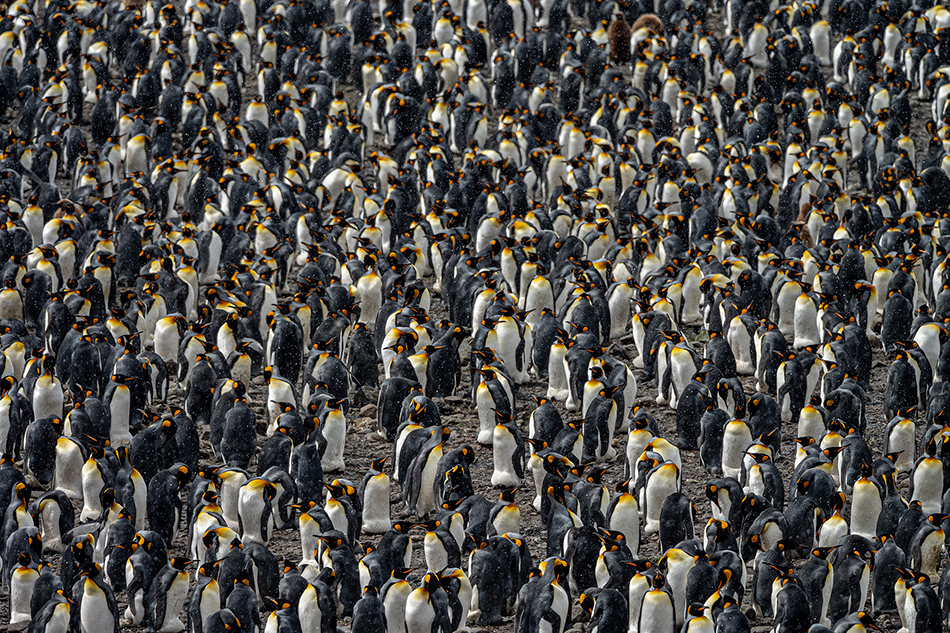
Look for patterns. One graphic quality that was ever present was pattern. Almost every penguin rookery was a colorful sea of shapes and pattern. Make sure to increase your depth of field to get more acuity in these shots. And remember…pattern interrupted can be even more interesting. Look for that solitary brown chick in a group of colorful adult king penguins.

Black and white. If you like black and white photography, you came to the right place. Striking icebergs and shafts of light present endless possibilities for graphic black and white photography. Look for distant icebergs your ship will pass and get be prepared to line them up just right for images.
Flat horizons. You will be shooting from ships and zodiacs a lot in Antarctica, and the ocean will be on the horizon. I always seem to have tilted ocean horizons, easy to correct in Photoshop, but better to get it right in the camera. Watch those horizons.

Emotive moments. There is so much wildlife in Antarctica. Look for those emotional moments…mothers and chicks interacting, courtship, preening. Baby fur seals often wrestle together on the beach in some locations. Your audience will always have a strong response to photographs that capture emotion.
Watch your exposure. You are often photographing on white snowy backgrounds, so be careful with your exposure. I was often adding 1-2 stops of exposure compensation to get the snow white in my image. Use your histogram to evaluate exposure. Penguin eyes are often shaded and surrounded by black feathers, so you may need to open up (let in light) to get any detail here.

Bad weather is good weather. We had a few snowstorms and it was perfect for photography. Slowly falling snowflakes around a group of penguins looks magical. Make sure you have a good rain cover and are comfortable using it. The weather can be nasty, but that is no reason to put your camera away…you might just get your best shots in a snowstorm.
Don’t fog your lens. After shooting for hours in freezing weather, make sure to leave your camera in your backpack when you return to your ship. Let it warm up slowly to avoid fogging your camera or lens.
Talk to your zodiac driver. Our guides were excellent on our trip, and they had a good sense of where photographers wanted to be. But they were always open to suggestions for better angles…don’t be shy about asking for a new angle while on the zodiac.
My last tip would be to bring a lot of flash cards and back up drives. I was on a three week trip visiting Antarctica, South Georgia and the Falklands…I shot 50,000 images. Make sure you have enough card space. Happy shooting!