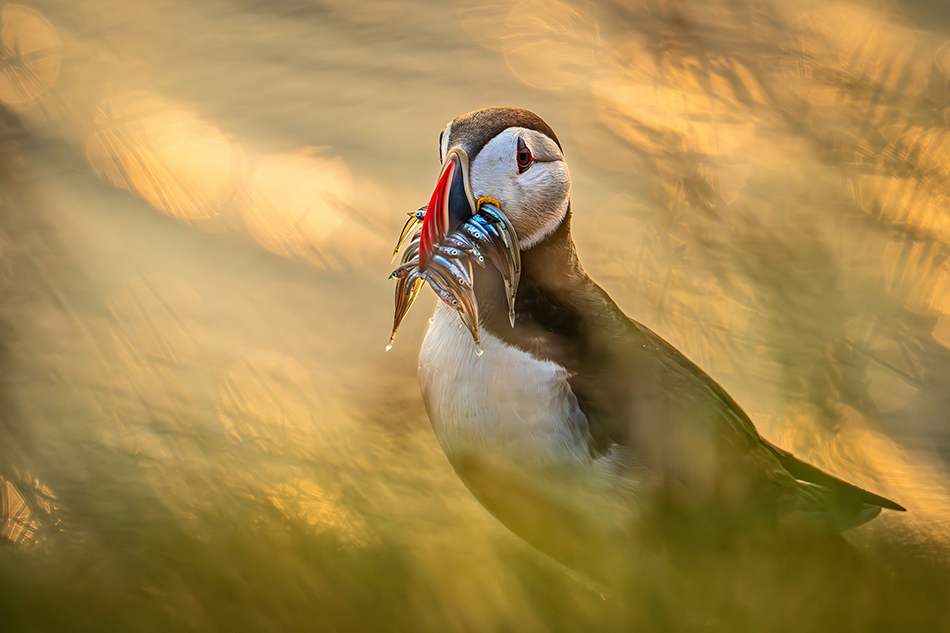
I just walked in the door from Iceland, had an incredible trip. I’ve been to Iceland many times, but on this trip we went to photograph puffins in addition to the amazing landscapes. Thanks to our incredible guides we photographed thousands of puffins, many with sand eels in their mouth (they were feeding chicks). I’ve never seen so many puffins in one place. By the way, did you know the most common bird in Iceland is the puffin? And the largest breeding colonies on the planet are also in Iceland. Pretty amazing.
The light went from sunny to overcast, and the action ranged from perching birds to flying birds. There was so much going on it was hard to focus. We were shooting in auto ISO and manual mode. But with the changing action, a familiar issue came up photographing the puffins: bracketing ISO to get the best image possible.
Here is the scenario. You are shooting puffins in flight at 1/4000 of a second, aperture at 5.6, and your auto ISO chooses ISO 6400 since it is low light and you are using a fast shutter speed. In this case, you need a high ISO for the fast shutter speed. But then the puffin lands right in front of you, and you continue to shoot at the same 1/4000 and ISO 6400. But the bird is now static. This is a moment where you can shoot at a much slower shutter speed, which in turn will bring your auto ISO way down. Try shooting a few frames at 1/250 which would bring your ISO to 400, resulting in a much better file.

It is true that noise reduction software is amazing, and I use it all the time. This image of a flying puffin was shot at ISO 6400, but noise reduction software like DxO, Topaz and Photoshop all do a good job reducing noise and making a usable image. I used high ISO because I needed a fast shutter speed to freeze the bird in flight.
But what is the end use of your image? If it is social media, your website or a small print, then ISO 6400 with noise reduction works great. But the reality is an image shot at a lower ISO looks better than an in image shot at a high ISO. Noise reduction helps reduce noise, but it doesn’t necessarily restore dynamic range, contrast and color that high ISO affects. If you can get a sharp file of a static bird at ISO 400 versus ISO 6400, I’m always going to shoot at the lower ISO. If you need more shutter speed to get a sharp image, then use a faster speed along with higher ISO to get the shot.

Maybe in the future image sensors get better at high ISO capture, noise reduction software continues to improve using AI, and it really won’t matter if you shoot at ISO 6400 or ISO 400. But for now I always bracket my ISO and use the lowest ISO I can for the best image possible. If I am in a quick changing situation, I stay in touch with my camera settings and adjust my ISO lower if I can. Try this test at home. Go out and shoot a low light scene at ISO 400 and ISO 6400. First compare the images and see the difference in quality, it should be significant. Next, use your favorite noise reduction software on the ISO 6400 and compare the images again, making sure to zoom into 100 percent and check the details. No matter what noise reduction software I use, the lower ISO image always looks better.
The take away…use high ISO when you need it for a sharp image, and use noise reduction software to produce cleaner images. But if the scene changes quickly and you can use a lower ISO, then use the lower ISO for a better quality file.